

Toolbox
Unsere Toolbox gibt es momentan nur auf Englisch:
Collaboratio helvetica supports the collective capacity to create, design and hold meaningful spaces and processes for collaboration. We are harvesting the learnings from all we do and share these openly. These tools that we use in our different projects are made available open source. This toolbox provides awareness based tools & methods for understanding and implementing system change includes a variety of conceptual frameworks, methodologies, and practical tools. They are structured by the following key components:
-
Understanding the interconnectedness and dynamics of systems is crucial. Concepts like feedback loops, causal loop diagrams, and systems mapping help identify leverage points and unintended consequences within a system. Learn to hold the tension between two opposing needs, forces or intentions. Identify double binds, and learn tools to side-step or break out from them.
-
Identify and understand the various stakeholders involved in the system, their interests, power dynamics, and relationships. Tools like stakeholder mapping and power-interest grids help in this analysis.
-
Clearly define the problem or issue within the system. Tools like the iceberg model, or problem trees, can help structure thinking around complex issues.
-
Powerful guiding and calling questions enable teams and communities to align their purpose and vision, and rally around transformative projects.
-
Cultivate awareness of blindspots, biases and stereotypes, seeing oneself and others as an integral part of the system(s) one tries to change. Prioritise ethical considerations and equity in all aspects of system change. Tools like equity impact assessments, participatory ethics frameworks, and community-based participatory research ensure inclusivity and fairness in decision-making processes.
-
Develop a shared vision for the desired future state of the system. Tools like visioning workshops, scenario planning, and backcasting help articulate long-term goals and pathways for change.
-
Crystallize learnings (from mapping, stakeholder interviews, sensing journeys, presencing, etc) and identify potential interventions and strategies for change. Tools like intervention mapping, strategy canvas, or theory of change frameworks help in planning and prioritising actions.
-
Engage diverse stakeholders in the change process through participatory approaches. Methods like co-design workshops, multi-stakeholder dialogues, and community engagement techniques foster collaboration and co-creation. Foster collaboration across sectors and disciplines to address complex systemic challenges. Tools like cross-sectoral partnership frameworks, boundary-spanning roles, and ecosystem mapping facilitate effective collaboration and coordination.
-
Establish metrics and indicators to track progress and assess the impact of interventions. Tools like logic models, outcome mapping, and social network analysis help in monitoring and evaluating system change efforts. Embrace flexibility and learning throughout the change process. Tools like feedback loops, adaptive management frameworks, and reflective practice facilitate continuous learning and adaptation.
-
Develop effective communication strategies to raise awareness, build support, and mobilize action. Tools like message framing, storytelling techniques, and social media analytics enhance communication and advocacy efforts.
-
Systems transformation starts with shifting individual mental models and broadening perspectives. Recognize the role of culture and individual behavior in driving system change. Tools like behavioral insights, exposing mental models, storytelling and cultural norms analysis support efforts to promote positive behavior change within the system.
-
Invest in building the capacity of individuals and organizations involved in system change efforts. Training programs, coaching, mentoring, and peer learning networks support skill development and knowledge exchange.
This toolbox is not exhaustive, and the specific tools and approaches will vary depending on the context and nature of the system being addressed. Flexibility, creativity, and an iterative approach to problem-solving are essential for navigating the complexities of system change effectively.
Search in our toolbox:
Systems Thinking

Jose Antonio Gordillo Martorell is the founder of Cultural Inquiry, and Catalyst from the Catalyst Lab cohort 2023–2024. With this blog post, he shares his personal experiences that have brought him to where he is now, and how the Catalyst Lab has empowered his personal growth along his journey towards change.

Funders typically go through a cyclical process when fulfilling their purpose. They strategise and make key decisions about what should be funded and how, to what end. Then, those who choose to be transparent communicate about this strategy and the process that enables it, for example with a call for applications or a page on their website explaining their funding approach and who is eligible…

More and more people agree that we need to work towards systemic change. But how can we define it, and where to begin? Systemic change can be understood as a change in how a system operates from the inside out. Besides deep shifts in the underlying paradigm(s), this includes changes in the Rules, Roles, Relationships and Resources that govern a given system (USAID, 2016).

I like to start with a story that impressed me when hearing it the first time, and I am still inspired when re-watching the video footage. It gave me a metaphor and scientific “evidence” for how subtleties can have huge and unpredictable ripple effects:

Systemic thinking is “like a language for describing and understanding, the forces and interrelationships that shape the behaviour of systems” (see more here: Fifth Discipline Fieldbook). With this approach it is possible to get away from the - often only short-term effective - treatment of symptoms and to concentrate on the deeper causes, which are mostly inherent to a system (see also the chapter on Root Causes and the Iceberg Model).

Along my participation in the Catalyst Lab, I have experienced an inner shift in the past months. The Catalyst Lab journey has provided me with valuable insights, a new understanding of my role in my system and deep connections with the most inspiring people. In one of the last modules one of the Catalysts mirrored back to me how he perceived me at the start of the journey and now. It resonated a lot and his correct assumption that I became more open towards other views and in some way more vulnerable allowed me to get into action and activate my ecosystem.

• a laboratory: a container of social experiments with intensive, experimental interventions
• a strategy for addressing complex ground-breaking social challenges on a systemic level.
• a space for multi-disciplinary collaboration, bringing together people from across the system aimed at key leverage points
• Social Labs consist of a team, a process and space(s) supporting social innovation and experimentation.

This blog is the first out of a series of my own journey into the 2nd cycle of the Catalyst Lab. This first part talks about learning how to listen to the echoes of the future through a collective network. It gives emphasis on the first step that preludes crystalizing a project - a step that is often overseen by society and the one that seems to be a must into real systemic change.

This model proposes a frame to think about the inner and outer work needed for impact. It is intended to make explicit what awareness-based systemic change takes and to support in creating as well as maintaining alignment and coherence across levels as we do this Work.

Social Innovation Labs are an emergent framework practiced by different types of organizations that includes governamental, non-profit, for-profit and a mix of them all. The key aspects of what constitute labs and the methodologies used by them can be a powerful framework for those seeking social innovation.

Sensing Journeys are an immersion into unfamiliar territories and offer a frame for exploring a specific place, organisation, challenge, or system through the lens of different stakeholders.

The ultimate goal of the Catalyst Lab is to prepare participants to apply what they learn at the Lab in their own context, and activate systemic change processes in different segments and sectors in Switzerland

Catalysing systemic change around a particular issue or topic is complex work, a match for the system you’re addressing and activating. There has been some degree of codification, theory and study around which approaches may help us do so. One of the approaches that has gained traction over the past years is the Lab approach, which in this context means bringing together a variety of stakeholders to co-create prototype solutions to complex challenges.

Instead of fighting the symptoms and clinging to old systems that don’t work anyways, let’s use this time to reflect and address the root causes to shape the Switzerland we want to live in. Staying in a state of busyness and jumping to (re)action may be comforting but if that’s what we focus on, we will never be addressing what got us into this situation in the first place. We are kicking off a series of blog posts as exploration around what these times are calling us to be and do

This is an overview of our core methods and awareness-based tools and approaches. It also includes links to proven practice tips, case studies and experiences from our facilitation in and for systemic change and social innovation.

Anyone can go through or host a u.lab journey, which is a 3 month process based on Theory U including an online MOOC complemented with the heart of it: offline deep and personal encounters with oneself and others.

The ecosystem map is a synthetic representation capturing all the key roles and dynamics that have an influence and interact with the environment of an entity (individual, team, organization).

“I was ready to work like a fool, but I wasn’t opened to the idea of sharing in a group what’s on my mind and heart. I was ready to figure out solutions for the problems out there, but I wasn’t ready to deal with my own weaknesses. I was ready to fight everything but myself.“

4D Mapping is an embodiment practice and is part of Theory U’s Social Presencing Theater. It is used when working with groups that want to explore their system, the embodied knowing of their bodies, to gain new insights.

At collaboratio helvetica, one of our key methods and principles is dialogue. By ‘dialogue’ we mean the kinds of conversations that change something in us when we take part in them, and that shift something between the people who are involved in the conversation. We mean dialogues where we need to “risk” being authentic and to co-create a space where others can do the same. We mean dialogues about challenging our habits of thought and conversation: listening with attention, speaking with intention and daring to turn the camera around to face ourselves and the roles we might have within the systems we are trying to change.

A Social Innovation Lab is first and foremost a way to address complex challenges, which cannot be solved by linear strategic planning.

The context of systemic change, societal renewal and its interconnected relationship to personal inner development is highly complex. In order to lead that change, we need robust articulation and depiction of the multilayered systemic challenges and possible pathways to solutions.
Stakeholder Mapping

Human - or sociometric - mapping is a technique in group processes that invites participants to physically position themselves on imaginary spectrums, circles or clusters in relation to certain statements and questions. Read on to find out why we at collaboratio helvetica are using it so often, and how it can backfire.

Collaboratio helvetica designed and facilitated an international and multilingual workshop for the Biodiversity Lab, a project by the Swiss association Brainforest.

Von September bis Oktober 2023 fand das Protein Lab statt, ein kollaboratives Projekt der drei Organisationen Sentience, der Berner Fachhochschule BFH und collaboratio helvetica. Die Workshopreihe zielte darauf ab, sektorübergreifende Lösungen für den Wandel des Ernährungssystems zu entwickeln.

Gesellschaftliche Herausforderungen sind komplex und anspruchsvoll. Oft scheint die Möglichkeit einer Verbesserung unerreichbar. In diesem Beitrag berichte ich darüber, wie mich die Methode der Stakeholder Interviews bei einer schwierigen Thematik weitergebracht hat. Es ist ein einfaches Mittel, um sich einen Überblick zu verschaffen und potenzielle Entwicklungsschritte zu erkennen.

In order to tackle the complex societal challenges we are facing, for instance around topics of climate change, migration, health etc., we need to come together across sectors and organisations and learn new ways of collaborating with each other, engage in meaningful conversations that go beyond polarization, learn from each other, and find new ways forward together. The challenges we are facing are too multilayered and complex to be addressed in a meaningful way just by one organisation or even one sector.

In multi-stakeholder workshops relevant stakeholders from a specific system (for example stakeholders linked to the healthcare system) come together around a specific calling question and topic to explore it in depth together, learn more about different perspectives and experiences, get a deeper understanding of the topic and identify leverage points for change. Ideally multi-stakeholder workshops take place as a series of events, where the same group comes together several times to explore relevant questions.

3D sculpting is an exercise that invites people to look at the reality of a system from different angles and perspectives with the aim to help identify the key strategic leverage points in changing the current system.

Stakeholder interviews are a tool that helps to sense, explore and gain a deeper understanding on different perspectives in a system. The tool has been developed by the Presencing Institute as part of the Theory U toolbox. Stakeholder interviews can be used at any stage of the U process and are a very useful tool to both sense into the system and get feedback on different aspects of your work. At collaboratio helvetica, we use this tool in most of our projects, for example in the Catalyst Lab, where participants do stakeholder interviews to explore the system and topic they are working on.
A Social Innovation Lab is first and foremost a way to address complex challenges, which cannot be solved by linear strategic planning.
Problem mapping

The iceberg model reveals deeper aspects of social and environmental challenges. Take plastic pollution in oceans: cleaning is crucial, but without addressing the root causes, we're stuck in a cycle. We must question the structures, laws, and mindsets that perpetuate this issue. Read our insightful blog post on understanding and addressing the iceberg model. Let's avoid repeating history and move beyond surface-level fixes to create lasting change.

The 3D mapping exercise aims to help unveil the multifaceted aspects of the system in which the Catalysts aim to achieve change. Working with my hands helped me to unearth aspects my mind alone did not “see”. Working in parallel with somebody else revealed interconnections within the Catalyst community.
My original goal when I joined the Catalyst Lab was to improve the work I do in helping the Swiss economy become more sustainable.
More and more people agree that we need to work towards systemic change. But how can we define it, and where to begin? Systemic change can be understood as a change in how a system operates from the inside out. Besides deep shifts in the underlying paradigm(s), this includes changes in the Rules, Roles, Relationships and Resources that govern a given system (USAID, 2016).

Cynefin, empowering to work with uncertainty
- refining our responses and practices depending on the specific system we engage with
3D sculpting is an exercise that invites people to look at the reality of a system from different angles and perspectives with the aim to help identify the key strategic leverage points in changing the current system.

The Iceberg Model: creating a shared map and understanding of the current reality and its root causes, and together inquiring into an aspired reality.
Catalysing systemic change around a particular issue or topic is complex work, a match for the system you’re addressing and activating. There has been some degree of codification, theory and study around which approaches may help us do so. One of the approaches that has gained traction over the past years is the Lab approach, which in this context means bringing together a variety of stakeholders to co-create prototype solutions to complex challenges.

If your mind is very preoccupied with thinking and you feel disembodied (e.g. like a head walking around), this is an effective way of arriving at the moment by feeling your body. This is a practice for embodiment and groundedness, also called mindfulness.

Naturally, in life we come to feel stuck in situations - be it in our professional or personal lifes, be it due to what feels like internal or external forces. Patterns in relationships with a boss, colleagues or family members tend to repeat until we change perspective.
The ecosystem map is a synthetic representation capturing all the key roles and dynamics that have an influence and interact with the environment of an entity (individual, team, organization).
Purpose & vision


For initiating any form of collaboration (incl. meetings, events, dialogues, trainings) a powerful calling & guiding question is essential for laying a healthy foundation for fruitful collaboration and meaningful outcomes.


collaboratio helvetica was founded on the experience that more conscious collaboration is needed in order to properly deal with systemic challenges such as the ones contained in the Agenda 2030, and a hunch that a different kind of working together with unlikely allies was key.

Holding the question is about bringing the focus away from the answer and back to the question. It is about putting as much thought into the question as we have traditionally given to answers. Holding the question is a method of opening the mind and asking life to respond.

I realized that my education has the power to influence me and change my values. In ways that goes beyond the knowledge I am taught, in ways that I am in fact blind to. As soon as I had this realization I could not deviate from it anymore. It was like a gate that had been opened, and as I continued to pay attention, it was not possible to close that gate again. In fact, it just became more open. I left the traditional education system, I went out into the world (and into the unknown) and decided on a path that I really wanted and felt I had truly chosen myself.
Awareness, ethics & equity

In Western society, intelligence is often equated with intellectual prowess – the ability to reason, analyse, and problem-solve. This logical, linear approach to knowing, championed by Descartes' famous dictum "cogito, ergo sum" (I think, therefore I am), has driven immense scientific advancement. However, over-reliance on this kind of knowledge may leave us disconnected from ourselves and the world around us.
In this blog post, Catalyst and facilitator Alexandra Choutko explores the importance of cultivating intuition to face the challenges of our time.

Alexandra Choutko is an experienced facilitator, and Catalyst from the Catalyst Lab cohort 2023–2024. With this blog post, she shares her personal experiences that have brought her to where she is now, and where her initial sense of disconnection in the Catalyst Lab led her to create an intervention in the form of a radical honesty workshop.
Have you ever thought about investing in Diversity and Inclusion (D&I) but then turned down the idea because you didn’t have the budget? And how many times did you consider setting up a D&I strategy but ended up abandoning the idea because you didn’t know where to start from? Or are you perhaps a team leader frustrated about the fact that leadership at the top is not taking enough action to move inclusion questions forward? We have been there!

Nora Refaeil’s Beitrag im Magazin “pm - perspektive mediation” befasst sich mit jüngsten, gesellschaftspolitischen Auseinandersetzungen zum Thema Rassismus in der Schweiz und mit der Frage, wie Rassismus mittels Dialog auf einer interpersonellen Ebene entgegengewirkt werden kann. Das darin beschriebene Konzept von Leadership soll einen möglichen Weg aufzeigen.
Swiss women fought a long, tough battle before they finally obtained the right to vote in 1971. 50 years later, we asked pioneering women from our network where things stand with equality today, in which areas progress still needs to be fought for and how women can become pioneers. Their responses show us that the future belongs to neither women nor men. Rather, it belongs to people with visions who take action to bring their ideas to life.

The 3 most important learnings of the Corona Crisis regarding diversity & inclusion in the workplace.

During the past year we have published an interview series with Gender and Diversity experts across sectors in Switzerland. Find here the key learnings out of our expert interviews. You can find the links to all the interviews at the end. Feel free to comment with your own tips!

An interview series with Gender and Diversity experts across sectors in Switzerland. How do they relate to their own gender? What are the current challenges and opportunities they see and what inspires them? The aim of this series is to bring awareness to gender and diversity work and inspire further action towards creating inclusive workplaces in Switzerland.
This is the recording of the online panel event on Gender, Inclusion and the Future of Work organised by collaboratio helvetica on June 10th 2020. The recording starts at the input part. The order of speaking is: Patricia Purtschert (University of Bern), Sylvie Durrer (Federal Office of Gender Equality), Robert Baker (Potentia Talent Consulting), Simona Scarpaleggia (Ikea), Nicholas Niggli (State of Geneva).

An interview series with Gender and Diversity experts across sectors in Switzerland. How do they relate to their own gender? What are the current challenges and opportunities they see and what inspires them? The aim of this series is to bring awareness to gender and diversity work and inspire further action towards creating inclusive workplaces in Switzerland.

An interview series with Gender and Diversity experts across sectors in Switzerland. Our second interviewee, Gilles Crettenand, is based in Sion and tells us what gender equality work looks like from the angle of men working amongst men.

This is the story of a facilitator who recognised and stepped into her role as a change agent. It is also a practical guide to inspire fellow process facilitators to reach out and support a different type of politics in their local area.

We have started interview series of Gender and Diversity experts across sectors in Switzerland. How do they relate to their own gender? What are the current challenges and opportunities they see and what inspires them? The aim of this series is to bring awareness to gender and diversity work and inspire further action towards creating inclusive workplaces in Switzerland.

How do we as individuals and organisations fully practice and embody gender equality? This was the calling question for the participants of the first-ever Social Innovation Lab on gender equality designed and hosted by collaboratio helvetica in Switzerland from 2017 to 2018.

If you want to discover and learn as a group what it means when e.g. Arnold Mindell talks about the essence level, and you want to make the energetical connection between people tangible and feelable for them, the Village Process is a great exercise to approach this learning.

Joharis Window is a very simple picture, that helps a group to understand the idea of giving feedback and sharing on a deeper level. Joharis window therefore help us to build community and the muscles we need to engage in real authentic dialogue with each other.

A Medicine Walk is a conscious time for diving deep into a specific question, to enter a state of deep listening and to be in touch with nature as a powerful mirror.

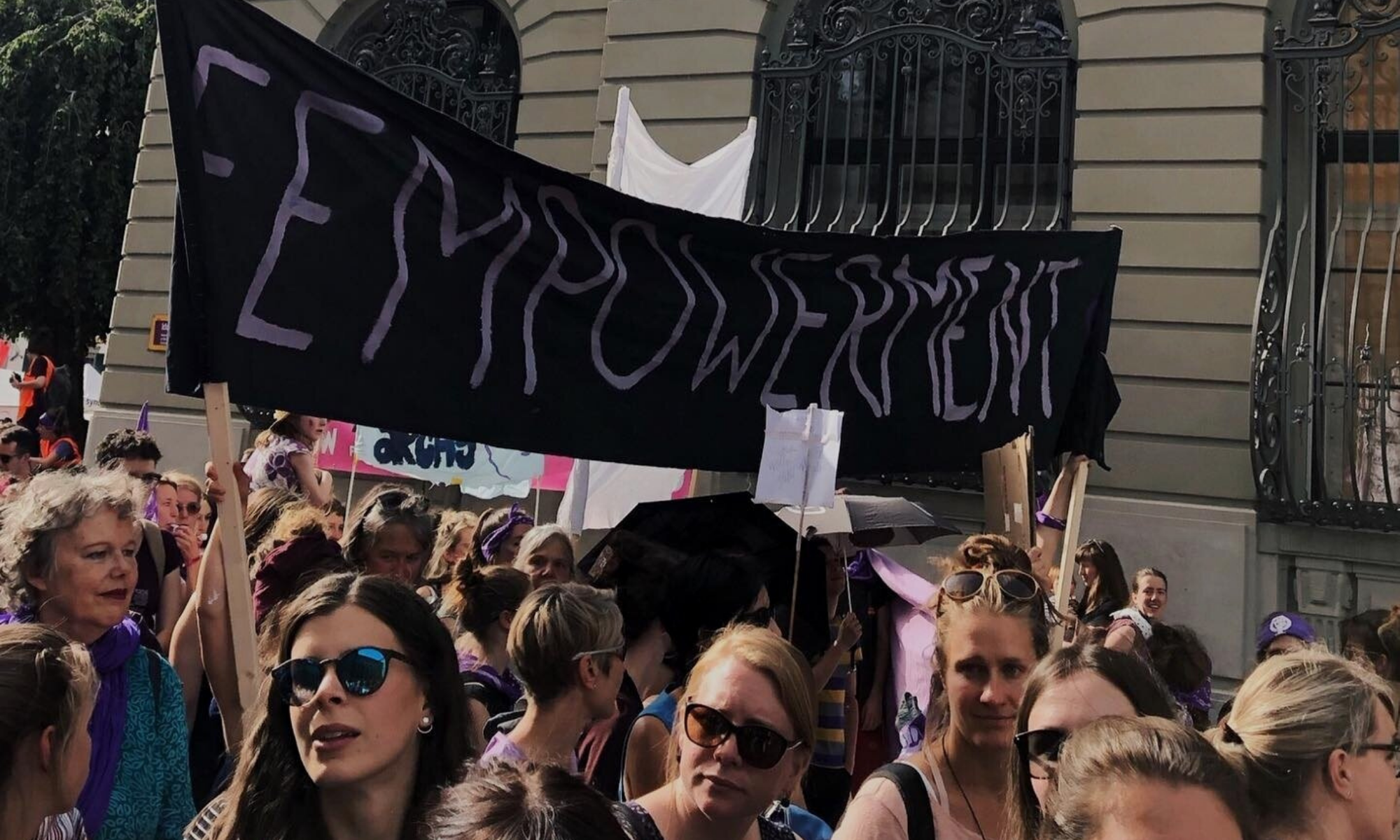
About last Friday’s #frauenstreik... Why did we go to the streets? A little bit of historical tragicomedy and some current facts to shed a light on the reality of Gender Equity in Switzerland in the year 2019.

With a lot of enthusiasm we supported the design and especially the flow of the morning for the SDSN Conference 2019 under the Motto “The Sustainability Transformation: A Joint Task for Our Society".

From September to December 2018 we collaborated with Sustainable Living Lab at Impact Hub Lausanne & Living Lab Lausanne at EPFL on a Social Lab called “Beyond Waste | Circular Resources Lab”. We are now ready to share many beautiful insights of our participants (individually and in their prototyping groups), extensive summaries of our Lab’s processes and also some meta topic articles.
“I was ready to work like a fool, but I wasn’t opened to the idea of sharing in a group what’s on my mind and heart. I was ready to figure out solutions for the problems out there, but I wasn’t ready to deal with my own weaknesses. I was ready to fight everything but myself.“

“Listening is probably the most underrated leadership capacity today, but listening is really at the source of all great leadership. When we see leadership failures, and today we have many opportunities to see that, very often, at the source of these failures is a lack of listening. A lack of connecting to what is really going on in reality right now.”

How can social laboratories be used to their full potential to address current societal challenges?

During our first cycle of the Social Lab on SDG 5 (Gender Equality) we learned that this method can be an impactful way to increase understanding and engagement for this topic. The purpose of a dialogue walk is to engage in deep dialogue, that means authentic listening and sharing.

Today there is no shortage of research, tools and analysis on the importance and implications of gender (in-)equality in our society and workplaces. However, as we all know, progress is difficult and slow. Why?

To be honest, I thought I knew quite a lot about gender and diversity but what I found was that I actually still don’t know that much, which was a shock and a huge pill to swallow!

On June 12, WeSpace invited representatives of women communities in Zurich to the first cross-women-communities event. WeSpace aimed to provide a physical space for the teams to meet, interact and share. However, we understood the need of professional expertise to be able to meet this goal, therefore, Collaboratio Helvetica was the obvious co-host. WeSpace aims to act as the home-base for women communities where interactions and collaborations can continue in the future.
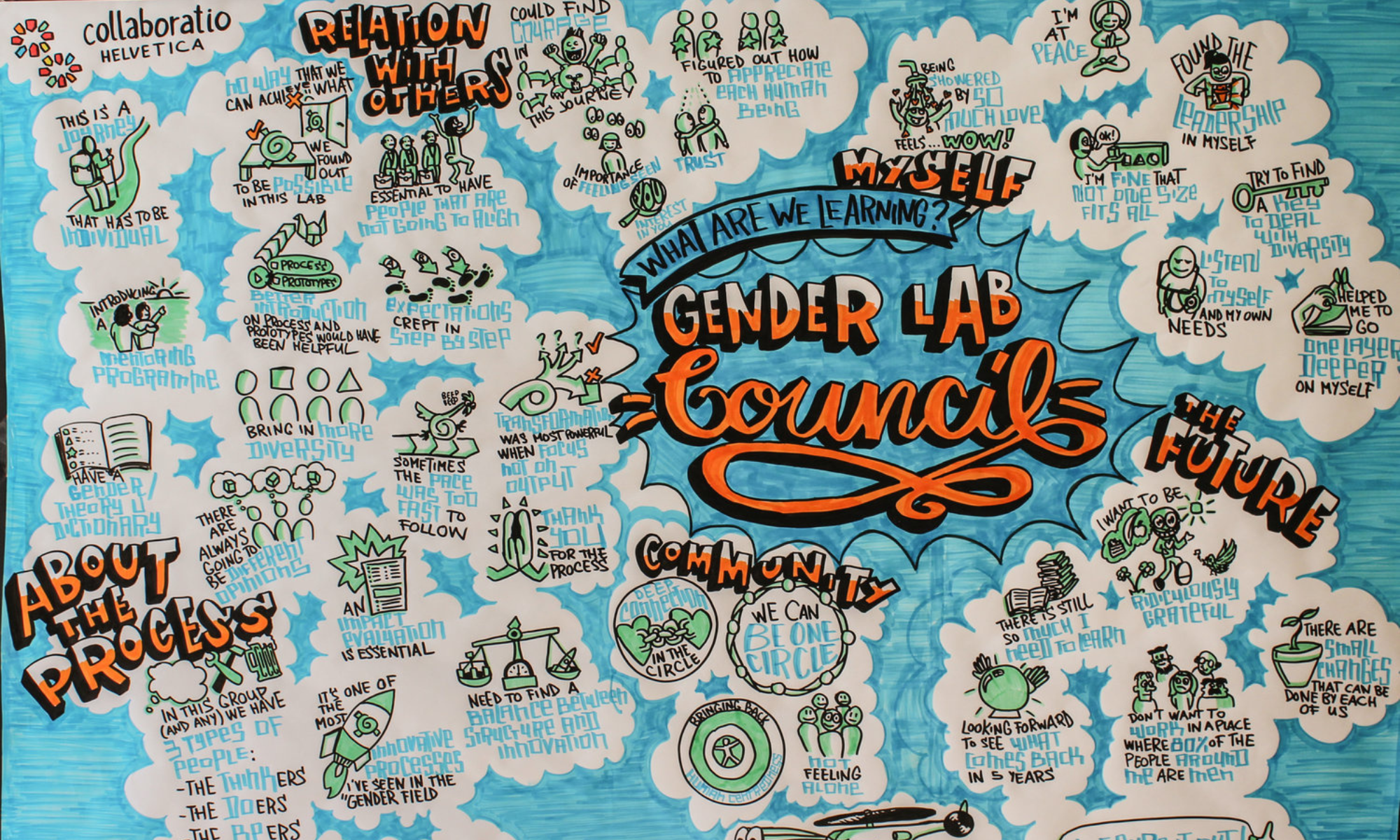
Eleven years ago, I made a conscious decision to wear my permanent Gender glasses.
Despite pursuing a Bachelor’s degree in Communication Studies, Rhetoric and Public Discourse at the time, when my influential university professor, Shira Tarrant, introduced me to the field of gender justice, my entire worldview drastically changed.
Theories of Change

The Theory of Change framework is designed to aid social innovation projects to hypothesise about the outcome and impact of their work, in order to be able to respond to rapidly changing contexts and emergent insights while remaining accountable to stakeholders and funders.

The CRM is a process for collective sense- making, typically used after co-sensing activities (sensing journeys or dialogue interviews). While 3D mapping gives a high level perspective from multiple angles, CRM allows participants to begin the process of physically embodying an experience.
4D Mapping is an embodiment practice and is part of Theory U’s Social Presencing Theater. It is used when working with groups that want to explore their system, the embodied knowing of their bodies, to gain new insights.

Check-ins are a way for people to have a dedicated space to share on a more personal level what’s happening within them. When practiced regularly and authentically, a teams purpose, coherence and trust can increase.
The context of systemic change, societal renewal and its interconnected relationship to personal inner development is highly complex. In order to lead that change, we need robust articulation and depiction of the multilayered systemic challenges and possible pathways to solutions.
Mapping Interventions & Strategies

Organisational learning is important for all contexts, yet more important still for innovative, action research-based, prototype driven initiatives. Dedicated to catalysing social change in Switzerland, collaboratio helvetica designs and runs prototypes and experiments in order to find ways to achieve this goal, and often the learnings from these are the most valuable outcome of the projects.
Gesellschaftliche Herausforderungen sind komplex und anspruchsvoll. Oft scheint die Möglichkeit einer Verbesserung unerreichbar. In diesem Beitrag berichte ich darüber, wie mich die Methode der Stakeholder Interviews bei einer schwierigen Thematik weitergebracht hat. Es ist ein einfaches Mittel, um sich einen Überblick zu verschaffen und potenzielle Entwicklungsschritte zu erkennen.

How to prepare, design and hold space for emerging and transformative collective action. Read here our findings and learnings of the Nova Helvetia journey.

Prototyping refers to building or creating a small but essential part of a larger project in order to see if it works as envisioned. It is rooted in ‘doing’ - development, testing, evaluating, reiterating. In the original framework of Theory U, it is the definitive step into concrete action, while staying closely connected to the deep mindset shift that happened in the previous steps of the Catalyst Lab journey and to the source of our intention.
• a laboratory: a container of social experiments with intensive, experimental interventions
• a strategy for addressing complex ground-breaking social challenges on a systemic level.
• a space for multi-disciplinary collaboration, bringing together people from across the system aimed at key leverage points
• Social Labs consist of a team, a process and space(s) supporting social innovation and experimentation.

During module 5 of the Catalyst Lab, the collaboratio helvetica’s team organised a one-day virtual prototyping workshop. The goal of the prototyping day was to support further the catalysts towards convening their systems and tap into the resources and knowledge of the community. The invitation was to get into a prototyping mindset and discover the benefits of experimenting with rapid prototyping tools, crowdsourcing, and co-creating with other changemakers working on diverse challenges, all while having fun. This workshop took place online due to restrictions linked to covid-19.
Sensing Journeys are an immersion into unfamiliar territories and offer a frame for exploring a specific place, organisation, challenge, or system through the lens of different stakeholders.

Die Transformation zu einer nachhaltigen Gesellschaft ist ein kollektiver Lernprozess. Zusammen mit verschiedenen Partnern haben wir an der SDSN Switzerland Konferenz 2019 sechs verschiedene 'Learning Journeys' unternommen.

In this blog I will share how we in the Dialogue context understand the word “feedback”. There are many different approaches to feedback. I want to show you a very efficient way of learning through feedback.

The prototyping canvas is a great tool to visually map out your prototype and get more clarity on its different aspects. It can be used when doing first attempts at a prototype to co-create it alone or with a group.

By ‘dialogue’ we mean the kinds of conversations that change something in us when we are part of them, and that shift something between the people who are involved in the conversation.
Collaboration
& Co-creation
Human - or sociometric - mapping is a technique in group processes that invites participants to physically position themselves on imaginary spectrums, circles or clusters in relation to certain statements and questions. Read on to find out why we at collaboratio helvetica are using it so often, and how it can backfire.

We often picture collaboration as a harmonious exchange of ideas, a well-oiled machine churning out success. But beneath the surface, unseen forces can disrupt this dynamic. Trauma, whether a past event or chronic stress, can leave its mark on our nervous system, impacting how we interact with colleagues. In this blog post, Matthias Ryffel discusses how trauma can impact collaboration at the workplace and how a trauma-informed approach can foster healing processes for a better work environment.
Alexandra Choutko is an experienced facilitator, and Catalyst from the Catalyst Lab cohort 2023–2024. With this blog post, she shares her personal experiences that have brought her to where she is now, and where her initial sense of disconnection in the Catalyst Lab led her to create an intervention in the form of a radical honesty workshop.

Peer reviews are an essential component for continuous improvement and accountability within any team. In a team working with Sociocracy 3.0 (S3.0), peer reviews can be particularly powerful as they align with the principles of collaboration, consent-based decision-making, and decentralised governance.
This’s a guide on how to conduct effective peer reviews in a team using Sociocracy 3.0.

Daphne Bucher looks back at seven successful years at collaboratio helvetica. In this blog post, she talks about her learnings regarding power dynamics, self-responsibility, and personal growth in a self-organised start-up environment.

Ever had those moments at gatherings where you left feeling like you didn't really learn anything about how people are doing? Or spent countless hours with family, yet still feel like they don't truly know you? In some social circles, it's always the same voices dominating the conversation, making it exhausting. 😓 And meeting new people? Breaking through the ice can be tough.

Zusammen mit Impact Hub Zürich und One Planet Lab hat collaboratio helvetica den Changemaker Workshop Bundling Forces organisiert.
How to prepare, design and hold space for emerging and transformative collective action. Read here our findings and learnings of the Nova Helvetia journey.

“You cannot buy the revolution. You cannot make the revolution. You can only be the revolution. It is in your spirit, or it is nowhere.”
― Ursula K. Le Guin, The Dispossessed

Our vision is that organisations in Geneva and beyond leverage their full potential to use innovation to respond to societal needs by transforming their employees into intrapreneurial leaders, connected to a wider community of changemakers and disruptors that are paving the way for the new economy.

What we usually say is that Radical Collaboration is both a toolset and a mindset. We can practice being together, in relationships with one another and the collective both on a practical level as well as on a more energetic and emotional level. To practice collaboration takes a lifetime to master. In this lifelong practice, we see the Catalyst Lab as a boot camp. In order to bring upon systemic change in the world, improving and deepening your relationships is a key skill and is, unfortunately, often underestimated and practised insufficiently.

This toolbox entry describes the dialogue principles we are using in the Catalyst Lab and in other formats like Social Innovation Labs or dialogue evenings. They will give you an idea of the kind of conversation we are inviting when practising dialogue. The dialogue principles serve as a basis for facilitating different dialogue methods, for example, triads, dialogue walks, or fishbowl.

A dialogue walk is a method in which two individuals explore a question in a deep conversation while being on a walk outside. It gives participants a space to dive into a deep conversation, practice authentic sharing and deep listening, and get to know each other's perspective and experience on a topic. It can be used as part of a dialogue event or also as a sharing tool in any other form of participatory workshop.

The way we listen and pay attention in a conversation can profoundly shift the quality and depth of that conversation, and the quality of relationship we are able to build to one another. Listening is probably the most underestimated leadership and community building skill.

Factory farming, animal suffering and agricultural practices that harm the environment shape my daily life, privately and at work. The Catalyst Lab presented me with the opportunity to open a dialogue space and expand my view on how others perceive the problem around these issues through a generative dialogue – a challenging and fascinating endeavour.

Since the first lockdown in March 2020 I was struggling with a challenge: how to transfer my activities into the digital world so I can continue to develop Let’s Talk Waste. Let’s Talk Waste is an entrepreneurial project I created in 2018 to cut plastic pollution at its roots. I offer team building activities to my clients who want to promote better team cohesion while creating a culture of caring for the planet and the environment. One of the tools I developed consists of two card games aimed at triggering discussions on the impact of littering and on challenging the relevance of recycling to promote sustainable behaviors.

Triads are a dialogue tool to share experiences and insights, witnessing and offering feedback in groups of 3.

What does good and clear conversation take? There is no “one single most” important thing but one aspect we are often unaware of is the setting in which we communicate or the stage for our communication if you use the analogy of conversation as a performance.

Facilitation is the art of unlocking the power of a group through dialogue and the pursuit of clarity, engaging active participation and embracing the richness of diverse perspectives. Through facilitation the multi-faceted potential of a team is released.” - Definition by the International Association of Facilitators

Understanding human behavior in groups is highly useful in design experience based events since group dynamics play a role in any human interaction. FIRO® is a comprehensive and widely-used theory of interpersonal relations created by Will Schutz.

Striving for the illusion of perfection can cripple our self-esteem as human beings, and completely stifle our progress as a team or organisation. Instead of being overly critical, blocking others for no valid reason or never getting out there out of fear of not being perfect enough, get into the GESET mindset!
With a lot of enthusiasm we supported the design and especially the flow of the morning for the SDSN Conference 2019 under the Motto “The Sustainability Transformation: A Joint Task for Our Society".

An ice breaker to build creative connectivity within a group for spontaneous speaking. Usually ends with lots of bubbling people.

This method helps you to the base for a trustful collaborative relationship. Sending a 30 is a metaphor, from the Radiant Transit exercise from Radical Collaboration, for sending an invitation to collaborate.
How can social laboratories be used to their full potential to address current societal challenges?

This is a simple method to harvest the group intelligence: A space where a “client” can ask for help of “consultants”. Can also be seen as a quick and powerful tool for coaching each other around specific and individual challenges.

PEMS is a tool/frame to help you design spaces, processes, services or other things in ways that enable a holistic and powerful experience.

This method helps you come up with new perspectives or ideas when you have a feeling that the creative process (of yourself or a group) is stuck or could benefit from some more creativity.

This is a beautiful method to facilitate a more personal connection between participants. It is best used rather in the beginning and can be kept general or it can also be modified to address the purpose of the workshop.

Taking a decision is a difficult thing to do by oneself, taking it together in a group can seem impossible. Creating an alchemy of all perspectives into a common agreement is a mastery and ensuring that the individuals then stick to the agreement is wizardry. Yet, collective decision making it is at the heart of a fruitful collaboration and we are confronted by it on a day by day basis. So how do we deal with this challenge?
Organisational Learning
Peer reviews are an essential component for continuous improvement and accountability within any team. In a team working with Sociocracy 3.0 (S3.0), peer reviews can be particularly powerful as they align with the principles of collaboration, consent-based decision-making, and decentralised governance.
This’s a guide on how to conduct effective peer reviews in a team using Sociocracy 3.0.
Daphne Bucher looks back at seven successful years at collaboratio helvetica. In this blog post, she talks about her learnings regarding power dynamics, self-responsibility, and personal growth in a self-organised start-up environment.

Collaboratio helvetica is self-organised and operates along the collaboration principles of Sociocracy 3.0. The collective decision was taken to embark on a learning journey and to explore the Conscious Leadership approach by the Conscious Leadership Group.
Organisational learning is important for all contexts, yet more important still for innovative, action research-based, prototype driven initiatives. Dedicated to catalysing social change in Switzerland, collaboratio helvetica designs and runs prototypes and experiments in order to find ways to achieve this goal, and often the learnings from these are the most valuable outcome of the projects.

Difficult conversations are an essential part of meaningful collaborations. A big part of changing the ways we work together implies changing the way how crucial conversations within an organisation take place. Many of the social tools we use at collaboratio helvetica, including dialogue, 4-levels of listening and liberating structures, among many many others offer different methods to have deep conversations that allow everyone to be heard, and any topic to be discussed. But are these conversations also successful in terms of outcome? Do we achieve what we gather for in the first place?
“You cannot buy the revolution. You cannot make the revolution. You can only be the revolution. It is in your spirit, or it is nowhere.”
― Ursula K. Le Guin, The Dispossessed
Prototyping refers to building or creating a small but essential part of a larger project in order to see if it works as envisioned. It is rooted in ‘doing’ - development, testing, evaluating, reiterating. In the original framework of Theory U, it is the definitive step into concrete action, while staying closely connected to the deep mindset shift that happened in the previous steps of the Catalyst Lab journey and to the source of our intention.

At collaboratio helvetica we believe in catalysing change by bringing people together and sharing an inner and outer exploratory journey, as a necessary preparation for collective action. What happens in such a collective space, like a Social Innovation Lab?
What takes place in such spaces, including the Catalyst Lab itself, is individual and collective learning. But what is learning, and how can we create and cultivate an environment where it can take place?

Any collaboration has its ups and downs and, if we are paying attention, offers an abundance of learning opportunities for all involved. Even when all are trained in collaboration tools, such as Sociocracy 3.0, and have developed key skills, such as self-awareness and listening, things are bound to go awry at some point.

From sometimes being overly naive and just believing whatever people were telling me despite evidence to the contrary to being worried and criticised for not “trusting” someone - I’ve had all kinds of experiences related to trust. Do you trust people always?
Since the first lockdown in March 2020 I was struggling with a challenge: how to transfer my activities into the digital world so I can continue to develop Let’s Talk Waste. Let’s Talk Waste is an entrepreneurial project I created in 2018 to cut plastic pollution at its roots. I offer team building activities to my clients who want to promote better team cohesion while creating a culture of caring for the planet and the environment. One of the tools I developed consists of two card games aimed at triggering discussions on the impact of littering and on challenging the relevance of recycling to promote sustainable behaviors.

Dedicated attention to a personal and ongoing practice is more of a necessity than a luxury in these times of navigating unprecedented changes. In this blog, we share a 5-fold approach to personal care in order to nourish our inner wellsprings and maintain a sense of groundedness and calm during these times.
During the past year we have published an interview series with Gender and Diversity experts across sectors in Switzerland. Find here the key learnings out of our expert interviews. You can find the links to all the interviews at the end. Feel free to comment with your own tips!
Anyone can go through or host a u.lab journey, which is a 3 month process based on Theory U including an online MOOC complemented with the heart of it: offline deep and personal encounters with oneself and others.
Understanding human behavior in groups is highly useful in design experience based events since group dynamics play a role in any human interaction. FIRO® is a comprehensive and widely-used theory of interpersonal relations created by Will Schutz.

Especially when working with big groups, hand signs can be very useful to share information without interrupting the process or take decisions swiftly.

Experiential learning is the process of learning through experience, and is more specifically defined as "learning through reflection on doing". It is a very effective strategy to create sustainable and inclusive learning experiences.

In this blog we want to introduce a very simple and practical tool to measure your X on your internal abilities skills map. It shows you your strengths and your weak spots so that you can decide where to focus your next learning steps as a space holder on.

The Pareto principle, also called the 80/20 rule, states that roughly 80% of results come from only 20% of efforts or causes. In the best of cases, applying this principle allows us to achieve more with working less, because we are smarter about how we invest our time.
Striving for the illusion of perfection can cripple our self-esteem as human beings, and completely stifle our progress as a team or organisation. Instead of being overly critical, blocking others for no valid reason or never getting out there out of fear of not being perfect enough, get into the GESET mindset!

Collaboratio helvetica is growing and we need new people to complement our team. To find the perfect fit, we used our own methods and invited five applicants to take part in a co-creation session in Berne. This gave us the opportunity to get to know each person, to see how they think and collaborate.
This is a simple method to harvest the group intelligence: A space where a “client” can ask for help of “consultants”. Can also be seen as a quick and powerful tool for coaching each other around specific and individual challenges.
Check-ins are a way for people to have a dedicated space to share on a more personal level what’s happening within them. When practiced regularly and authentically, a teams purpose, coherence and trust can increase.

Collaborating in a team and community where we want to respect and consider the contribution of everyone can be a difficult task, both in theory and even more so in practice. Often, agreements are made without considering all the important actors involved or when they are involved reaching an agreement can be a lengthy and often unsuccessful ordeal.
Taking a decision is a difficult thing to do by oneself, taking it together in a group can seem impossible. Creating an alchemy of all perspectives into a common agreement is a mastery and ensuring that the individuals then stick to the agreement is wizardry. Yet, collective decision making it is at the heart of a fruitful collaboration and we are confronted by it on a day by day basis. So how do we deal with this challenge?

In December 2017, collaboratio helvetica (cohe) began to recruit some new team members to join its core team. The process was unusual: Over one month, around 25 people were brought together in different spaces, from whom 2-3 were subsequently selected to join the team. Why would cohe do this? Cohe is an organisation dedicated to creating spaces for open dialogue, experimentation and collaboration to create the Switzerland we want to live in. It is an organisation that tries to lead by example: trying new methods and approaches, and learning as it does so. It is also a very small organisation, juggling many commitments, projects, contacts and trying to do big, complex things on a small budget. Therefore, the right team members are crucial.

When a group of people must tackle a common complex challenge you can release their inherent creativity and leadership as well as their capacity to self-organize. With the Open Space method all issues that are most important to the participants are raised, included in the agenda and addressed. With the co-created agenda people will take responsibility very quickly for solving problems and moving into action. Letting go of central control (i.e. the agenda and assignments) and putting it in the hands of everyone generates commitment, action and innovation.

A council is a way to open spaces that encourage attentive listening as well as honest and compassionate expression. It allows a new group of people to get in touch with each other very quickly and in an authentic way.

To work during holidays or go on holidays and work at the same time sounded very counterintuitive to me. I thought no way could this mix be productive or regenerative, specially not both at the same time, right? A great experience with my new colleagues taught me otherwise.
Communication & Advocacy
Von September bis Oktober 2023 fand das Protein Lab statt, ein kollaboratives Projekt der drei Organisationen Sentience, der Berner Fachhochschule BFH und collaboratio helvetica. Die Workshopreihe zielte darauf ab, sektorübergreifende Lösungen für den Wandel des Ernährungssystems zu entwickeln.

To achieve system change - a large-scale change that will affect everyone - funding the social innovation process itself effectively is key. Such an innovation process requires cross-sector collaborations that shift the focus from fighting the symptoms to addressing the root causes. Given the urgency for systemic change, foundations have been exploring new effective funding mechanisms that support system change.
Cynefin, empowering to work with uncertainty
- refining our responses and practices depending on the specific system we engage with

Citizen Assemblies: A way for a participative deliberative decision-making process to find a pathway for solving complex problem.

FlowConnection – eine ganzheitliche Lernreise für Unternehmen zu mehr Flow, Kommunikation und Zusammenarbeit.
Vor dem Hintergrund der von Collaboratio Helvetica ins Leben gerufenen Initiative „Nova Helvetia“, die lösungsorientierte Projekte für eine gesunde Post-Covid-19 Schweiz begleitet und unterstützt, begaben sich Hartmut Hübner und Diana Oser in ihren jeweiligen Projektteams auf eine 3-monatige Reise. Hartmut interessierten die Aspekte des „New Work“-Ansatzes und wie sich diese in Unternehmen integrieren lassen, so das Arbeitnehmern und Unternehmen davon auf nachhaltige Weise langfristig davon profitieren können (SDG 8).

When a deeper examination of oneself and the society is needed – the principle and values of extinction rebellion and why I joined them.

I am not a techno-optimist. I agree with Doug Tompkins that over many millenia, technology has made us disconnected from nature, and paved the way for the Anthropocene, a newly defined geological era in which humans are shaping the planet to their immediate benefit, having lost sight of the deep, finely tuned interconnectedness of all living beings that created our planetary eco-system.
What does good and clear conversation take? There is no “one single most” important thing but one aspect we are often unaware of is the setting in which we communicate or the stage for our communication if you use the analogy of conversation as a performance.

Our Catalysts again in the media with their amazing projects! Alexandra Gavilano and Andreas Dutli.

The Dialogue Spiral is a model that shows us as facilitators and as participants how any group process naturally develops, what phases a group will experience in a natural flow of conversation, and how to identify what underlying dynamics is at play in that process.
From September to December 2018 we collaborated with Sustainable Living Lab at Impact Hub Lausanne & Living Lab Lausanne at EPFL on a Social Lab called “Beyond Waste | Circular Resources Lab”. We are now ready to share many beautiful insights of our participants (individually and in their prototyping groups), extensive summaries of our Lab’s processes and also some meta topic articles.

It's been over a year since the 10th UNESCO Youth Forum, and the echoes of this experience, especially the people I met, are still present. There is so much potential in supporting young people who are stepping up and getting their hands dirty. Thanks for the shout out, UNESCO!

Collective Story Harvesting is a storytelling process that enables us to deeply connect with and learn from the experience in our community, team or organization. It builds our capacity for targeted listening, group learning and therein for collective meaning making. Collective Story Harvesting takes learning to a deeper level as it surfaces insights that exist beneath the surface of our stories.

Am 15. Februar 2018 kamen in Bern 250 Menschen zusammen, um das Sustainable Development Solutions Network Schweiz SDSN zu lancieren und um die Schweiz einige Schritte weiter in Richtung Agenda 2030 zu bewegen.

By "Dialogue" we mean the kinds of conversations that change something in us when we take part in them, and that shift something between the people who are involved in the conversation.
Cultural & Behavioural Change
We often picture collaboration as a harmonious exchange of ideas, a well-oiled machine churning out success. But beneath the surface, unseen forces can disrupt this dynamic. Trauma, whether a past event or chronic stress, can leave its mark on our nervous system, impacting how we interact with colleagues. In this blog post, Matthias Ryffel discusses how trauma can impact collaboration at the workplace and how a trauma-informed approach can foster healing processes for a better work environment.
Jose Antonio Gordillo Martorell is the founder of Cultural Inquiry, and Catalyst from the Catalyst Lab cohort 2023–2024. With this blog post, he shares his personal experiences that have brought him to where he is now, and how the Catalyst Lab has empowered his personal growth along his journey towards change.
Ever had those moments at gatherings where you left feeling like you didn't really learn anything about how people are doing? Or spent countless hours with family, yet still feel like they don't truly know you? In some social circles, it's always the same voices dominating the conversation, making it exhausting. 😓 And meeting new people? Breaking through the ice can be tough.

Im Jahr 2020 überstieg die Masse von Menschen geschaffener, unbelebter Objekte – die anthropogene Masse - zum ersten Mal das Trockengewicht allen Lebens auf der Erde, einschliesslich Menschen, Tiere, Pflanzen und Pilze und sogar Mikroorganismen. Dabei betrug sie im Jahr 1900 erst 3% der Biomasse. Sie hat sich seither alle 20 Jahre verdoppelt…
Our vision is that organisations in Geneva and beyond leverage their full potential to use innovation to respond to societal needs by transforming their employees into intrapreneurial leaders, connected to a wider community of changemakers and disruptors that are paving the way for the new economy.

Having never founded my own NGO or worked in anything other than a commercially oriented company, I’m somewhat an outlier in this year’s Catalyst Lab. As collaboratio helvetica’s mission is to fundamentally change how we work together I was often asked what the difference is between working my day job and supporting the Catalyst Lab team in my communications role. Well then, let’s try to find out.
Along my participation in the Catalyst Lab, I have experienced an inner shift in the past months. The Catalyst Lab journey has provided me with valuable insights, a new understanding of my role in my system and deep connections with the most inspiring people. In one of the last modules one of the Catalysts mirrored back to me how he perceived me at the start of the journey and now. It resonated a lot and his correct assumption that I became more open towards other views and in some way more vulnerable allowed me to get into action and activate my ecosystem.

Unser Engagement und unsere Intention für eine andere Welt ist oft nicht messbar und doch deutlich spürbar. Dies erschwert die Kommunikation darüber und erfordert noch mehr Selbstvertrauen in unser Wirken. Mich interessieren mittlerweile genau solche, langsamere Prozesse für die noch kein Messgerät erfunden wurde und unsere innersten Werte, Menschlichkeit, Herzens-Intelligenz und Intuition die Richtungen angeben. Das Catalyst Lab hat mich in dieser Demut und Geduld bestärkt, um das Grössere, Verbindende schätzen zu lernen, systemische und strukturelle Verbindungen zu sehen.

„Ich denke an die Zukunft. Ich weiss, dass wir so längerfristig nicht weiter machen können. Wir brauchen einen Wandel. Unsere Zukunft und die der zukünftigen Generationen liegt mir unglaublich am Herzen. Irgendwie habe ich mir das alles besser vorgestellt, als ständig an diese nicht so vielversprechenden Aussichten zu denken. Ich habe dieses Gefühl in mir, dass das alles nicht gerecht ist, und wir das doch ändern können, auch wenn es nur kleine Erfolgsschritte sind...”

Dedicated attention to a personal and ongoing practice is more of a necessity than a luxury in these times of navigating unprecedented changes. In this blog, we share a 5-fold approach to personal care in order to nourish our inner wellsprings and maintain a sense of groundedness and calm during these times.

In a short time, life has dramatically changed. Will we go back to the way things were or is this a #newnormal? We have entered into the unknown. Uncertainty is omnipresent. No one knows how things will turn out.
Triads are a dialogue tool to share experiences and insights, witnessing and offering feedback in groups of 3.
A Medicine Walk is a conscious time for diving deep into a specific question, to enter a state of deep listening and to be in touch with nature as a powerful mirror.
In this blog we want to introduce a very simple and practical tool to measure your X on your internal abilities skills map. It shows you your strengths and your weak spots so that you can decide where to focus your next learning steps as a space holder on.
The Pareto principle, also called the 80/20 rule, states that roughly 80% of results come from only 20% of efforts or causes. In the best of cases, applying this principle allows us to achieve more with working less, because we are smarter about how we invest our time.

Guided journaling is a self-reflective process, allowing participants to access deeper levels of self-knowledge, based on a set of prepared questions. The reflection is spontaneous and happens through the writing itself, by just writing down what emerges in the moment (instead of first thinking and reflecting, and then writing down the reflections).

Why do many people who try to make a difference often feel frustrated or angered because the world isn’t changing fast enough for them or that some people do not share their awareness about an issue?
Collective Story Harvesting is a storytelling process that enables us to deeply connect with and learn from the experience in our community, team or organization. It builds our capacity for targeted listening, group learning and therein for collective meaning making. Collective Story Harvesting takes learning to a deeper level as it surfaces insights that exist beneath the surface of our stories.
Capacity Building

In this blog post, Marie-Claire Graf, Catalyst from the cohort 2021-2022, gives insight into her project and the impact collaboratio helvetica and the community still has on her.
In Western society, intelligence is often equated with intellectual prowess – the ability to reason, analyse, and problem-solve. This logical, linear approach to knowing, championed by Descartes' famous dictum "cogito, ergo sum" (I think, therefore I am), has driven immense scientific advancement. However, over-reliance on this kind of knowledge may leave us disconnected from ourselves and the world around us.
Zusammen mit Impact Hub Zürich und One Planet Lab hat collaboratio helvetica den Changemaker Workshop Bundling Forces organisiert.
Von September bis Oktober 2023 fand das Protein Lab statt, ein kollaboratives Projekt der drei Organisationen Sentience, der Berner Fachhochschule BFH und collaboratio helvetica. Die Workshopreihe zielte darauf ab, sektorübergreifende Lösungen für den Wandel des Ernährungssystems zu entwickeln.

Wie soll eine Ernährungspolitik für die Schweiz aussehen, die bis 2030 allen Menschen gesunde, nachhaltige, tierfreundliche und fair produzierte Lebensmittel zur Verfügung stellt? Zu dieser Frage hat sich während fast 6 Monaten der erste nationale Bürger:innenrat getroffen.

Here, you will find templates of a dossier, timeline, budget and financing plan. Have fun experimenting with it!
Difficult conversations are an essential part of meaningful collaborations. A big part of changing the ways we work together implies changing the way how crucial conversations within an organisation take place. Many of the social tools we use at collaboratio helvetica, including dialogue, 4-levels of listening and liberating structures, among many many others offer different methods to have deep conversations that allow everyone to be heard, and any topic to be discussed. But are these conversations also successful in terms of outcome? Do we achieve what we gather for in the first place?

Should donor foundations also invest in the infrastructure of non-profit organisations? Over 30 participants from big and small foundations and associations explored this question in a recent online workshop co-hosted by collaboratio helvetica and proFonds. Looking at this topic from both the prism of two donor foundations and from the perspective of one grantee organisation helped participants to gain a deeper understanding of the benefits and possible pitfalls of such funding as well as consider next steps.
Citizen Assemblies: A way for a participative deliberative decision-making process to find a pathway for solving complex problem.

How do you arouse the enthusiasm of your audience? As a change maker, you need to onboard your stakeholders. Let’s have a look at how Erik Turner, participant of the Catalyst lab cohort 2020/2021, pitched his idea of creating a sustainability certificate at the Zurich sustainability week.

Both practice and a growing body of research show that the complex challenges we are facing, such as climate change and inequality, will not successfully be addressed with current thinking. Indeed, no single organisation nor sector can hope to reach one of the goals set in the Agenda 2030 alone.
Dedicated attention to a personal and ongoing practice is more of a necessity than a luxury in these times of navigating unprecedented changes. In this blog, we share a 5-fold approach to personal care in order to nourish our inner wellsprings and maintain a sense of groundedness and calm during these times.
The ultimate goal of the Catalyst Lab is to prepare participants to apply what they learn at the Lab in their own context, and activate systemic change processes in different segments and sectors in Switzerland
Facilitation is the art of unlocking the power of a group through dialogue and the pursuit of clarity, engaging active participation and embracing the richness of diverse perspectives. Through facilitation the multi-faceted potential of a team is released.” - Definition by the International Association of Facilitators

Creating and Facilitating a Dialogue Evening is an Art and is a learning by doing process. It cannot be planned or prepared for all the emerging questions, issues, unknowns and possible possibilites. An inner presence and openness is crucial.

Successfully catalysising systemic change requires many abilities, skills, internal and external pre-conditions. In the context of the Catalyst Lab, we have created a first iteration of the Catalyst Spiderweb. It is a tool for self-inquiry and assessment and defines 12 aspects the Catalysts can rate themselves on.

A picture is worth a thousand words, and equally - one sculpture or gesture can share a lot about how we are actually feeling. Perhaps, we even uncover something we had not verbalised.
Especially when working with big groups, hand signs can be very useful to share information without interrupting the process or take decisions swiftly.
Experiential learning is the process of learning through experience, and is more specifically defined as "learning through reflection on doing". It is a very effective strategy to create sustainable and inclusive learning experiences.

The flying agenda is basically about facilitating a team process. The following description is very detailed not to be rigid about it, but for you to understand the thinking behind it. What matters is the spirit and the general idea of it. So feel free to adapt this to your context and needs.
This method helps you come up with new perspectives or ideas when you have a feeling that the creative process (of yourself or a group) is stuck or could benefit from some more creativity.
A council is a way to open spaces that encourage attentive listening as well as honest and compassionate expression. It allows a new group of people to get in touch with each other very quickly and in an authentic way.

To serve the purpose of collaboration and co-creation, we share our materials and learnings in the domain of the Creative Commons, under a CC BY-SA 4.0 license.